Let Homies run it for you
How do you decide which chores go on the chart?
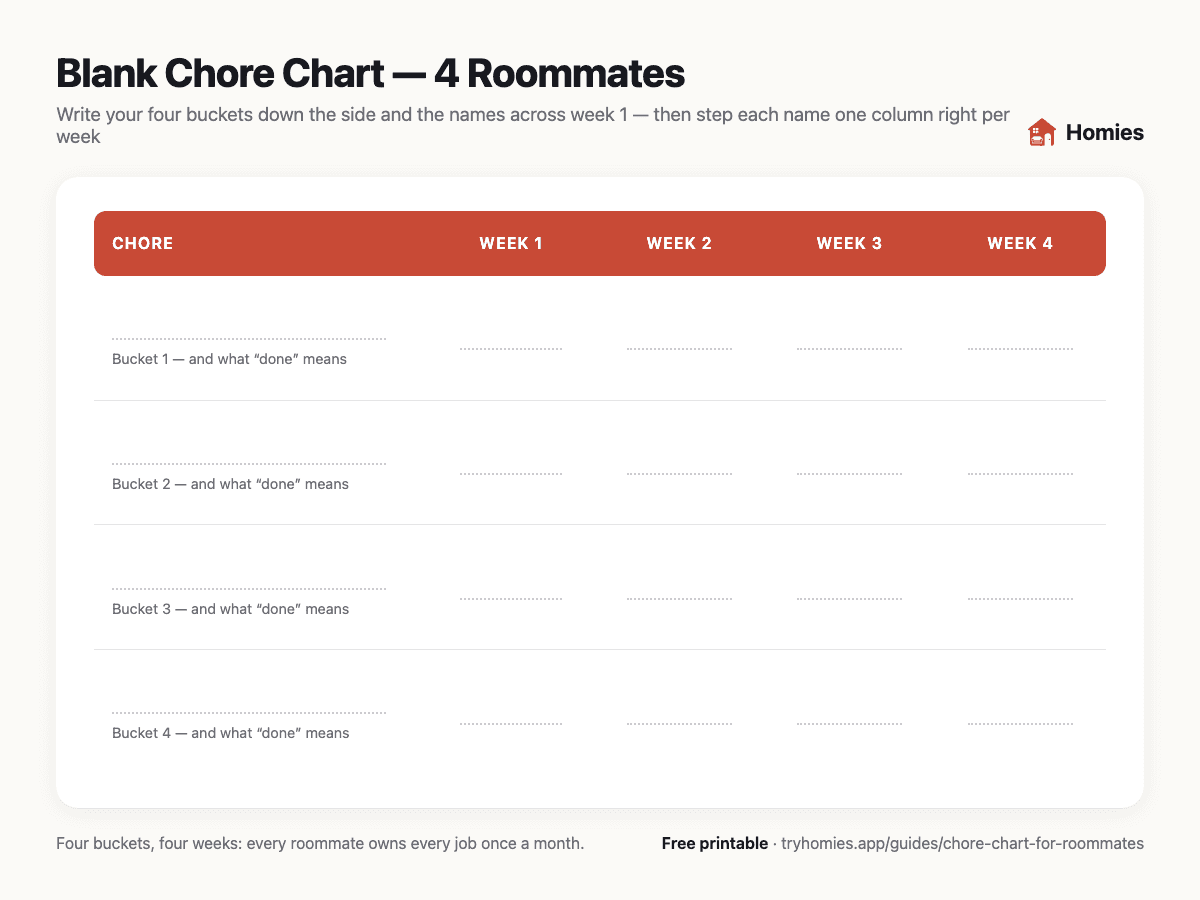
Before you assign anything, walk the apartment. Don't trust memory. The setup is three steps:
- List every recurring task and how often it truly needs doing. A typical four-person flat lands on something like: kitchen wipe-down (daily), take out trash and recycling (twice weekly), bathroom clean (weekly), vacuum and mop common areas (weekly), and the big ones people forget: fridge clear-out, shower drain, and oven (monthly).
- Write the frequency next to each task, because that's what makes a split fair. 'Clean the bathroom' once a week is a much bigger job than 'wipe the counters' which someone does in 20 seconds. If your chart treats them as equal, resentment is baked in from day one.
- Group chores into weekly buckets of roughly equal effort. Now you have something you can rotate cleanly.
How should you rotate chores between roommates?
The single biggest reason chore charts fail is that the worst job gets permanently glued to the most agreeable person. The fix is a rotation: every task shifts to the next roommate each cycle, so the toilet-scrubbing week belongs to everyone in turn. With four people on a weekly rotation, you each own the grim jobs once a month and the easy ones the other three weeks. That predictability is what makes people stop arguing.
Decide your cycle length up front. Weekly is the sweet spot for most flats; bi-weekly works if everyone's tidy and busy. Pin the rotation somewhere everyone sees it, because a chart taped to the fridge that nobody updates is just decoration. This is where an app earns its keep: Homies, a roommate app for the whole home, sets up recurring chores once, then auto-rotates each task to the next person on schedule, so the chart updates itself instead of relying on someone to redraw it every Sunday.
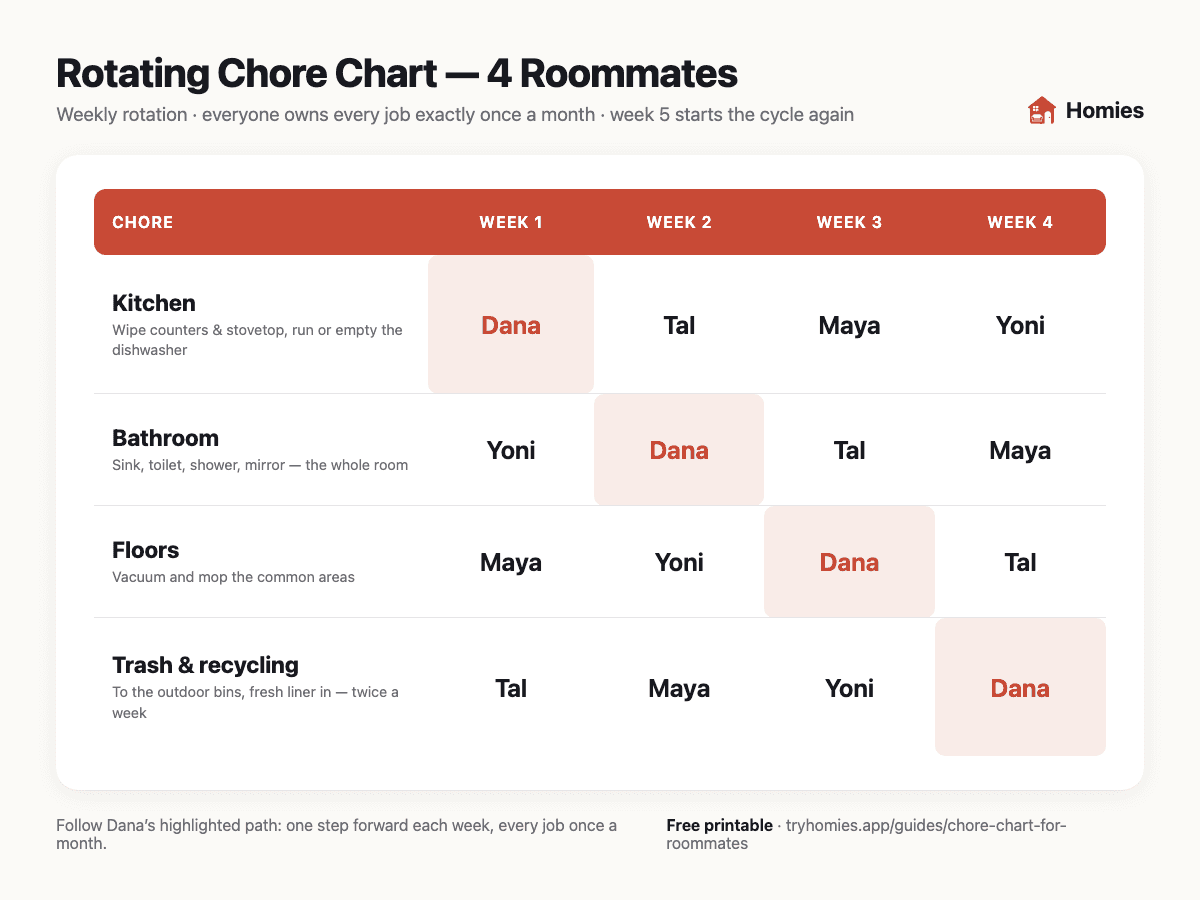
Here's the four-week version for a four-person flat, using the buckets from the previous section. Everyone owns every job exactly once a month, and week five starts the cycle again:
| Chore | Week 1 | Week 2 | Week 3 | Week 4 |
|---|---|---|---|---|
| Kitchen | Dana | Tal | Maya | Yoni |
| Bathroom | Yoni | Dana | Tal | Maya |
| Floors | Maya | Yoni | Dana | Tal |
| Trash & recycling | Tal | Maya | Yoni | Dana |
How do you turn the chart into a weekly cleaning schedule?
A chore chart answers who; a cleaning schedule for roommates answers when. Without the second half, "bathroom week" quietly becomes "bathroom Sunday at 23:40", and the roommate who cleans on Monday spends six days looking at everyone else's crumbs. The fix is attaching each chore bucket to a fixed day, which does two jobs at once: it ends the when-negotiation, and it makes a skipped turn visible the same day instead of festering into a vague feeling that nobody cleans around here.
Write the days next to the buckets on the chart — the printable above has room for them — and pair the schedule with a short set of house rules for roommates, so the daily standards (dishes same-day, counters clear) hold between cleaning days. A weekly cleaning schedule that works for a four-person flat:
- Daily: a ten-minute kitchen reset after dinner — counters wiped, dishes in the machine, nothing left to crust overnight.
- Twice a week, on fixed days (say Monday and Thursday): trash and recycling go out, owned by whoever holds the trash bucket that week.
- Weekly, one fixed day each: bathroom on Sundays, floors on Wednesdays — tied to whoever holds that bucket in the rotation.
- Monthly, first weekend: the forgettables — fridge clear-out, shower drain, oven — split on the spot between whoever's home.
How do you define when a chore is done?
Half of all roommate friction isn't about who did the chore: it's about what 'done' means. One person thinks taking the trash to the kitchen door counts; the next person wants it in the outdoor bin with a fresh liner in. Kill that gap by writing a short checklist under each chore. 'Kitchen' becomes: wipe counters, run or empty the dishwasher, take out trash, wipe the stovetop. Now there's no debate about whether it was finished.
Sub-task checklists also make rotation honest, because the next person inherits a known standard instead of someone else's shortcuts. In Homies, each recurring chore carries its own checklist, so 'trash' isn't marked complete until the bag is actually tied and replaced, small thing, but it's the difference between a chart that works and one everyone quietly abandons.
How do you divide chores fairly when schedules aren't equal?
Equal isn't always fair. If one roommate works nights, travels constantly, or cooks every dinner for the house, a rigid even split breeds quiet resentment. A few fairer models: trade chores for cooking (the person who cooks five nights a week skips kitchen duty), weight by time (two quick jobs equal one heavy one), or let people draft their preferences: someone who genuinely doesn't mind dishes can swap away the vacuuming they hate.
Whatever you pick, agree on it together and write it down, then revisit it every couple of months as schedules change. And separate chores from money: time spent on tasks shouldn't quietly settle a debt over the $75 electricity bill. Keep the chore chart for effort and a clear shared-expense balance for cash, so neither one becomes a bargaining chip in the other.
Frequently asked questions
What's the best rotation length for a roommate chore chart?
Weekly works for most shared flats: it's frequent enough that nobody owns the worst job for long, and short enough to stay top of mind. If your household is small and tidy, bi-weekly can be plenty. The key is that the rotation is automatic and visible, so the schedule advances without anyone having to remember to update it.
How do we handle a roommate who keeps skipping their turn?
Make it visible rather than personal. When the chart clearly shows whose turn it is and what 'done' means, skipped chores are obvious to everyone, which is usually enough social pressure to fix it. For repeat offenders, agree on a house rule up front, a small swap, a make-up week, or a kitty contribution, so it's a system, not a confrontation. And if nothing changes even then, you're past chart territory: here's how to deal with a messy roommate without moving out.
Should chores and shared expenses be tracked together?
Track them in the same place, but keep them as separate ledgers. Effort and money don't convert cleanly, and trading 'I did the bathroom' against 'you owe me $15' gets murky fast. Homies keeps recurring chores and a who-owes-who expense balance side by side without blending them, so each stays fair on its own terms.
Is there an app that does this automatically?
Yes, that's the whole idea behind Homies. Set up recurring chores once, add sub-task checklists, and each task auto-rotates to the next roommate on schedule, alongside shared expenses and a real-time shopping list. Homies is one app for the whole home (money, chores, and a quiet who's-home presence): no ads, no nagging, no per-feature paywalls. It's in closed beta now on iOS and Android, free while we build it. Join now and you're in early, with one signup for the whole household — we'll email you the moment your spot opens, one message, no spam.
Let Homies run it for you
What these guides set up by hand, the app runs on its own: the chore chart fills itself, balances settle in a tap, and the shopping list stays current for everyone. Homies is in closed beta now: join and you're in early, free while we build it.